Published on:
Last updated on:
There was a time when being a good video editor was enough.
You built a portfolio, shared it when needed, maybe posted occasionally, and clients would come through referrals or outreach. That model still exists, but it no longer scales. More importantly, it no longer compounds.
In 2026, the problem is not skill. It is visibility combined with clarity.
Clients are no longer searching deeply. They are scanning. They are not comparing ten editors side by side. They are reacting to what feels immediately right.
As one editor put it:
“There are thousands of good editors. The ones getting paid more are just easier to find and easier to trust.”
Personal branding today is not about looking impressive. It is about making yourself easy to understand, easy to evaluate, and easy to hire.
How clients actually decide who to hire
Clients do not evaluate the way most editors expect.
They are not sitting down to carefully review portfolios. They are moving quickly, often under pressure, and making decisions based on pattern recognition.
They scroll. They notice something that looks familiar. They click. They decide.
Most hiring requirements we get at Cutjamm reflect this clearly:
“60 videos per month… 15–60 seconds… Fast turnaround (24–48 hours)… captions, sound effects, B-roll.”
This tells you something important.
Clients are not buying potential. They are buying certainty.
Your personal brand must remove thinking from the decision. If a client has to interpret your work, you are already creating friction.
Positioning: where most video editors lose before they start
Most editors position themselves in a way that forces the client to do extra work.
“Video editor” does not mean anything to a buyer.
A stronger approach is to make your work immediately contextual.
Instead of describing your skill, describe your outcome.
For example, "helping founders turn podcasts into short-form clips with strong retention" is far more powerful than simply saying you edit videos.
This level of clarity does two things. It narrows your audience, and it sharpens your relevance.
When positioning is clear, the client does not evaluate broadly. They recognise specifically.
Why showreels alone are losing relevance
The traditional showreel has one problem. It shows ability, but not relevance.
A fast montage of clips might look impressive, but it does not answer the client’s real question:
“Can this person do exactly what I need?”
That is why structured portfolios perform better.
When your work is organised by context, such as podcast clips, short-form content, or ad creatives, the client no longer has to imagine fit. They can see it instantly.
Relevance reduces hesitation. And hesitation is what kills conversion.
Content is how your thinking becomes visible
Content is often misunderstood as marketing activity.
In reality, it is a mechanism for trust.
When you show before-and-after edits, you are not just showing improvement. You are revealing judgment.
When you explain why a cut works or how pacing affects retention, you are demonstrating that you understand outcomes, not just tools.
This is what separates editors who are seen as replaceable from those who are seen as valuable.
The goal of content is not to impress. It is to make your decision-making process visible.
Your portfolio is not the problem. Discovery is.
Most editors assume they need better work to get more clients.
In reality, their best work is simply not being seen in the right context.
The traditional portfolio model is static. You build a website, upload a few samples, and wait for someone to visit.
But that is not how discovery works anymore.
Today, a portfolio should not just exist. It should be encountered.
This is why a layered system works better.
A website still matters because it acts as your decision layer. It should be clean, focused, and easy to scan.
Platforms like YouTube add depth by allowing you to organise your work into niche-specific playlists.
But discovery requires something else entirely. It requires your work to be visible without effort from the client.
A look at Cutjamm: where discovery meets hiring
For most video editors, personal branding stops at content and a video editing portfolio.
But there is a gap between being seen and being chosen.
This is where platforms like Cutjamm become important.
The problem it solves
Even when clients find you, they still need to:
compare multiple editors
evaluate different styles
decide who fits
This creates friction and slows hiring.
How Cutjamm changes the process
Instead of searching across websites, clients interact with a public feed of real edits.
They can:
scroll through actual work
filter by niche or style
immediately recognise what matches their needs
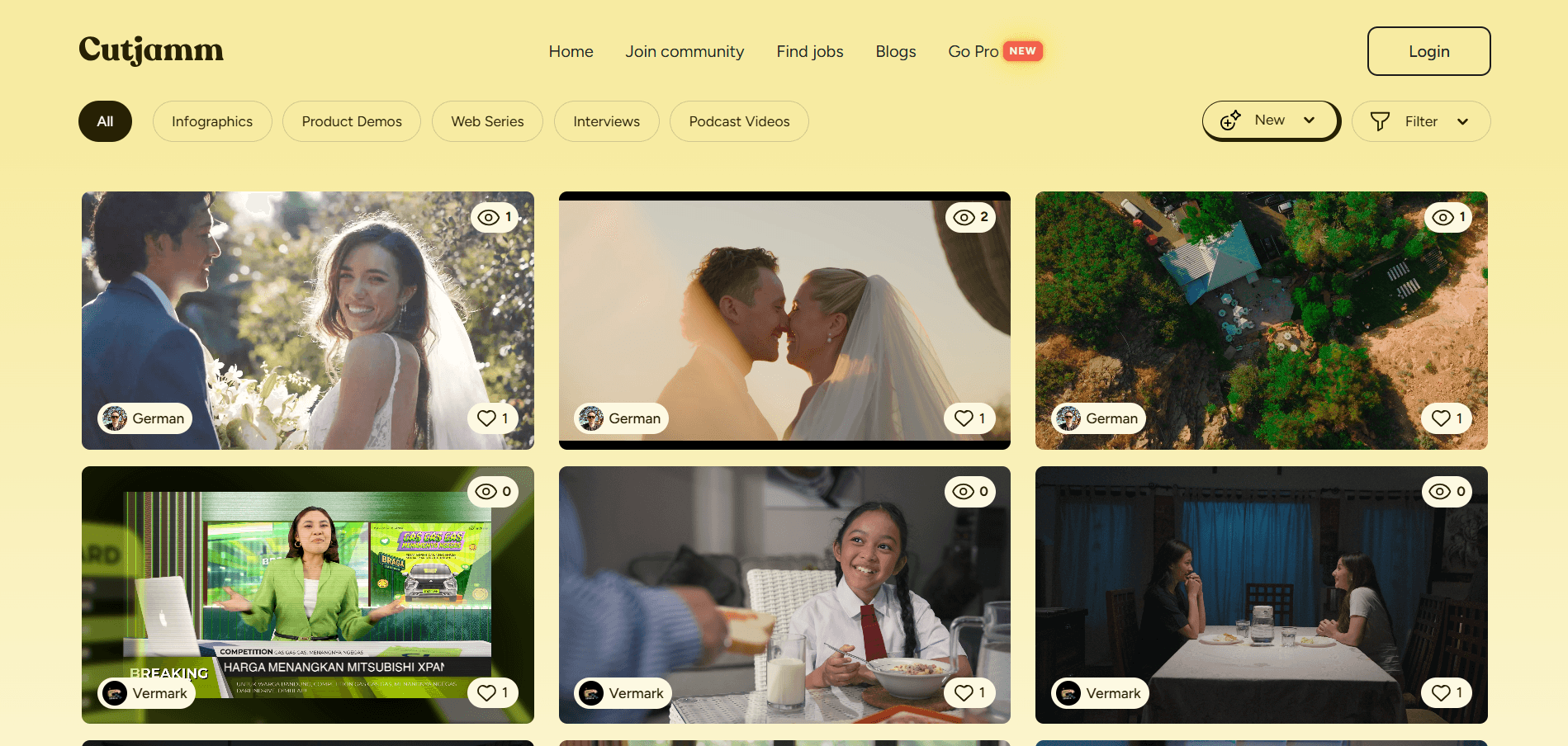
From the client’s perspective, the process becomes intuitive:
They are not analysing. They are reacting.
They see something that looks right, and they move forward.
What this means for your personal brand
Cutjamm turns your editing output into a live discovery system.
Your work is no longer hidden inside a portfolio link. It is continuously visible in a context where clients are already looking.
This has two major effects:
First, it reduces the effort required for clients to evaluate you.
Second, it shortens the distance between discovery and hiring.
In many cases, clients are able to identify the right editor within minutes, because the platform itself acts as a filter.
Where it fits in your overall system
Think of your brand as three layers:
Your YouTube/Instagram/X builds depth and proof
Cutjamm creates visibility, builds credibility and structure and enables fast hiring
Each layer solves a different problem.
Without discovery, your portfolio waits.
With discovery, your work works for you continuously.
The system that actually compounds
When you connect everything, a simple system emerges.
You create content that shows your thinking.
You upload your best work into Cutjamm where it can be discovered.
You maintain a clean portfolio for decision-making.
Over time, this creates a loop.
Content brings attention.
Discovery platforms surface your work.
Clients evaluate quickly.
Decisions happen faster.
This is what turns a personal brand into a client acquisition system.
Outreach still matters, but it plays a different role
Outreach is no longer your starting point.
It is your amplifier.
When a client has already seen your work, your message carries context. You are not introducing yourself. You are reinforcing recognition.
This changes how outreach should be done.
Instead of long explanations, short, specific observations work better.
Referencing a piece of content, suggesting a small improvement, and showing a relevant example is often enough to start a conversation.
In some cases, outreach becomes unnecessary altogether. When your discovery system is working, clients come in already convinced.
Do you still need a website?
Yes, but its role has changed.
A website is no longer your primary source of traffic. It is your validation layer.
It answers the final questions before a decision is made.
Are you credible?
Is your work consistent?
Can you be trusted?
But discovery happens elsewhere.
That is why relying on a website alone is limiting. It shows your work, but it does not ensure that your work is seen.
What actually moves the needle
When you step back, the difference between struggling and growing editors becomes clear.
It is not skill.
It is structure.
Editors who grow consistently:
position themselves clearly
organise their work by relevance
make their thinking visible
place their work where clients are already looking on platform like Cutjamm
They reduce friction at every stage of the decision.
And that is what makes them easy to choose.
Final thought
Your personal brand is not what you say about yourself.
It is how quickly a client can understand you, trust you, and decide to work with you.
In 2026, the editors who win are not just skilled.
They are clear.
They are visible.
And they are easy to choose.
🙋♀️ Frequently Asked Questions (FAQs)
Q: How long does it take to build a personal brand as a video editor?
A: With consistent execution, most editors begin to see traction within three to six months. The key factor is consistency, not intensity.
Q: Should you focus on one platform?
A: Start with one platform where your clients are active, and support it with a second platform that strengthens your proof.
Q: Should you rely only on a website?
A: No. A website builds credibility, but it does not create discovery. Combining it with platforms like Cutjamm ensures your work is visible and easier to evaluate.